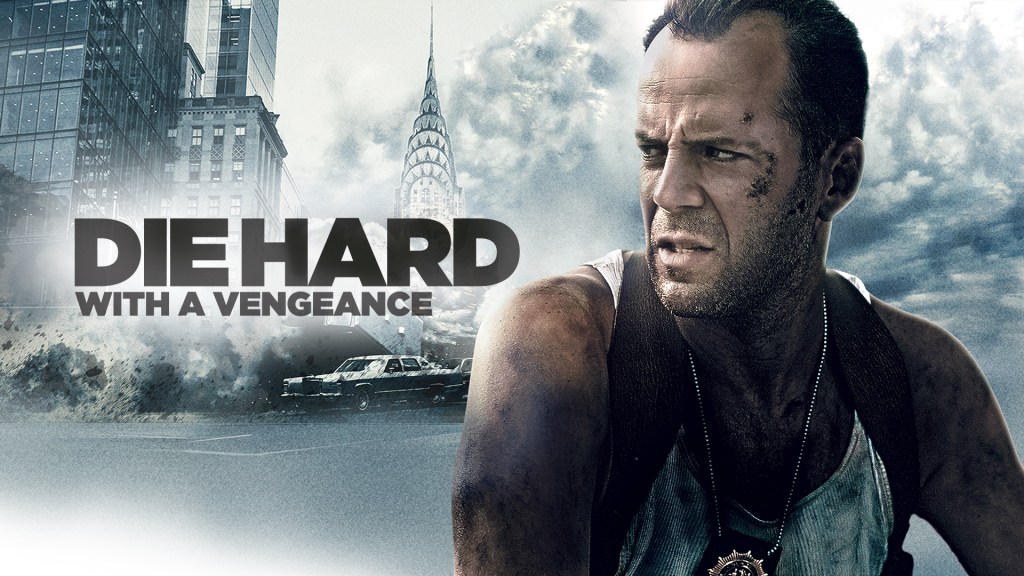
This intro paragraph is usually where I’d try to assert that today’s subject, Die Hard with a Vengeance, is a better film than the first, but that’s not true. It is, however, my favorite in the series and the first one I saw in the theaters, when I was probably still a bit young for this type of action flick. This entry is arguably the best sequel, and every time I go back to it, I learn something about DHwaV I didn’t know or had forgotten, so let’s discuss some interesting bits.
Jonathan Hensleigh wrote the third installment and saw the director of the original, John McTiernan, return to the chair, turning down Batman Forever in the process. We join our hero, John McClane (Bruce Willis), at a low point in his life, drowning in alcohol and forced back from suspension early. As if the work and family problems weren’t enough to deal with alongside this raging hangover, now a terrorist has placed bombs all across the city, sending him on a wild goose chase to defuse them by solving riddles and puzzles. Simon (Jeremy Irons) isn’t just here to mess with McClane, however, because there’s a bigger plot that involves stealing a lot of gold and getting away with it, unless one New York cop and his new friend, Zeus Carver (Samuel L. Jackson) can throw a couple of wrenches into these plans.
DHwaV followed the series trend of being repurposed material not originally intended for the series, after Willis and the producers had grown tired of proposed stories that were simple retreads of the first movie. One of the initial scripts of note was Troubleshooter, which would have pit McClane against terrorists on a cruise ship in the Caribbean had it not been deemed too close to Steven Seagal’s upcoming action vehicle, Under Siege. There were rumors for quite some time that this script eventually became Speed 2: Cruise Control, but that seems to be highly contested; though it’s possible that the proposal was an inspiration. One potential script would have resembled Taken, seeing McClane’s daughter kidnapped, while another had terrorists taking over the subways in Los Angeles, which had an ending that was eventually used for the first Speed movie. The eventual winner was a movie called Simon Says, a project in the works for Brandon Lee until his untimely death while filming The Crow. First, it went through Warner Bros., who wanted the story for a potential Lethal Weapon entry, but it was later purchased by 20th Century Fox and rewritten to join the Die Hard family.
To this point, McClane had typically been alone in his adventures, his allies were either stuck outside or not getting involved in the action, but it’s kind of neat seeing him have someone to bounce off of in between shooting henchmen. Zeus isn’t a sidekick, more an unconventional partner. It works because of Jackson’s performance, one he says is close to his real personality, and the chemistry he shares with Willis, as the two verbally spar, crack jokes, and spit one-liners as they traverse the city. So it’s wild to think this role was first offered to Laurence Fishburne, who wanted more money to play the role. As fate would have it, though, the head of Cinergi, Andy Vajna, attended the Cannes premiere of Pulp Fiction and liked Jackson’s performance of Jules Winnfield so much he offered the actor the part of Zeus instead. This had to upset Fishburne somewhat, as he was talked out of accepting the Pulp Fiction gig under the idea that he should only be going after lead roles. Vajna’s decision to hire Jackson broke a verbal agreement, and Fishburne was well-compensated for that. I like Larry, but I think they made the right choice.
McTiernan’s first choice for the villain of his film was actor Sean Connery, who felt the character was a little too diabolical and most likely would have given me horrible flashbacks to The Avengers. Recently, I learned that one of the bad guys, Roman, was played by a former wrestler from the WWF, the briefly notable Ludvig Borga. That would have been a small fun bit of trivia if the man hadn’t had such a controversial career afterward, and now there is a whole Dark Side of the Ring episode on him.
Most people know about the film’s alternate ending, where McClane tracks down Simon and plays his own little game with the terrorist, involving a rocket launcher. Some people think that sequence is a bit cruel and even hurts McClane’s character, but either way, it’s a tad awkward. There was another, however, one that they never filmed because it was discarded early in production, presumably due to it resembling the ending of Die Hard 2 too closely. This other ending would have seen McClane and Zeus after the boat explosion, with Carver lamenting the villain’s escape. In this version, the bomb from the elephant fountain wasn’t used to try and kill John in the tunnels. It was instead left on the terrorists’ vessel, forcing Simon to try and solve his water puzzle, with the dark and comedic line of asking if anyone had a four-gallon jug. Though that does make me chuckle a little, none of the endings are great.
Hensleigh has said that the first hour or more of the film is all from his original script, just with different characters inserted into it, and the second half was heavily rewritten. I feel that kind of explains the downgrade. Although the entire movie is good, starting with a literal explosion and keeping the energy high for most of the run, the last act after the boat explodes brings the explosive ride down a bit.
There’s a novelization of this movie written by Deborah Chiel, and I need to track it down. Not only does this version apparently keep the darker tone, exploring McClane’s thoughts on the events in a more broken mental state, but it also adds details to the backstories, additional scenes, and uses the “McClane Says” rocket launcher ending. The book does feature less Katya (musician Sam Phillips), who, I, being legally blind, did not realize had scars on her throat, likely the reason for her being mute. Maybe it was from that bomb that was mentioned earlier in the film, the one they thought got her. I don’t feel too bad, most people know that the vehicle that arrived carrying all the bad guys to Nakatomi Plaza in the first movie said Pacific Courier, but missed that this one has an Atlantic Courier truck, just before it is blown up with the department store in the beginning. That’s neat.
DHwaV faced several problems outside of filming. The writing for the Federal Gold Reserve heist was so good and well-researched that Hensleigh was detained and interrogated by the FBI at one point, actually concerned he might be in trouble. It was the editors who had to worry, though, as the original cut received an NC-17 rating. Many of the death scenes had to be shaved down or changed, while McClane’s fight with the big man, Targo, was diced up as well. Some of the behind-the-scenes features show other versions of these sequences. Once McTiernan was confident they had secured the R rating, he added a last-minute sex scene between Simon and Katya, but there isn’t much there. The film was censored even more for its UK release in an attempt to get younger audiences in.
A bigger hurdle happened one month before release, when a real-life terrorist attack saw the Alfred P. Murrah Federal Building bombed in Oklahoma City. There were claims that the movie would be edited, even McTiernan considered removing the opening scene for audience sensitivity, but this never happened. The studio stuck with the version of the film they had and their original release date, standing on the fact that it was a work of fiction and finished before the bombing happened.
Sometimes the sequel underperforms while the third installment picks up the slack, maybe even doing something slightly new and still keeping the tone. It felt good not seeing McClane trapped somewhere, running around a city, his city, playing against the bad guys with a home field advantage. We also got to see a little bit of character growth, repercussions for his heroic actions in the first film, kind of catch up with Holly, John finally admitting to being an asshole, and see him make a new friend after fighting with him for the first half. New York looks amazing here and is shot so well, giving us visuals that help match the steady pacing, even though our main bad guy doesn’t show up on screen until about 50 minutes in, and McClane doesn’t kill anyone until over an hour of the runtime has passed. This installment truly wanted to try and break the mold. Too bad we missed out on Al Powell, though. Apparently, Reginald VelJohnson was booked up with his work on Family Matters (I love that show). He did, however, host a feature for the film.
DHwaV received mixed reviews, but that doesn’t matter if people only remember it as the highest-grossing film of 1995. It has some flaws, sure, and the ridiculous television edits gave audiences a few laughs, but it’s certainly memorable and stands out. Whether most people like it for the action, clever writing, actors, or getting to see John McClane in his element one more time, it’s almost certainly the best sequel and remains my favorite of the bunch.